
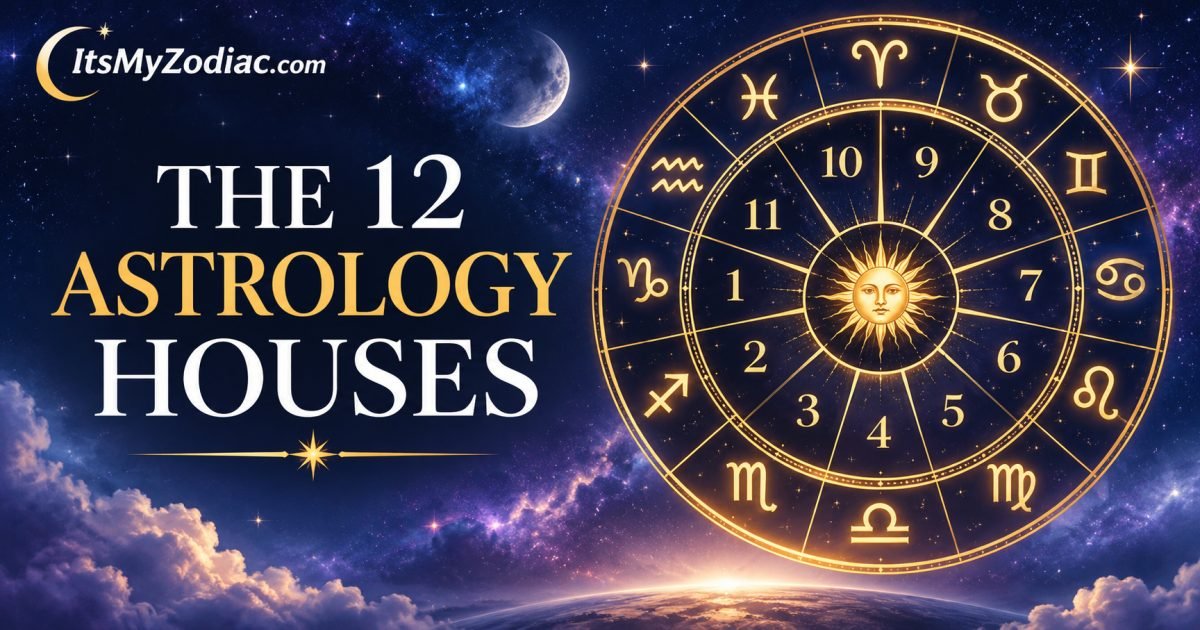
When you explore your birth chart, you will notice that it is divided into twelve sections called astrological houses. Each house represents a different area of life, helping astrologers interpret how planetary placements connect with everyday experiences, personal relationships, ambitions, and personal growth.
Understanding the twelve houses makes it easier to go beyond your Sun sign and explore the deeper structure of your natal chart. In Western astrology, the houses work alongside zodiac signs and planets to create a more complete picture of an individual's astrological profile.
What Are the 12 Houses in Astrology?
The twelve houses are divisions of a birth chart, with each one associated with a particular area of human experience. They cover subjects ranging from personal identity and finances to relationships, career, friendships, and the subconscious.
In simple terms, planets describe what is being expressed, zodiac signs describe how that energy is traditionally interpreted, and houses show where those themes may appear in life.
For example, Venus is associated with love, attraction, and personal values. If Venus appears in the seventh house, astrologers may interpret its themes through partnerships and close relationships.
The houses are calculated using birth time and location, which is why accurate birth information matters when creating a natal chart.
What Does Each of the 12 Astrology Houses Mean?
1st House: Self, Identity, and First Impressions
The first house represents your sense of self, personal identity, appearance, and approach to new experiences. It begins at the Ascendant, also known as the Rising Sign.
Astrologers associate this house with how you present yourself, take initiative, and interact with the world around you. It provides an important starting point for interpreting the entire birth chart.
2nd House: Money, Possessions, and Personal Values
The second house is associated with personal finances, income, material possessions, and self-worth. It also represents the resources and abilities you value and develop.
When interpreting this house, astrologers consider themes such as financial priorities, spending habits, personal security, and the relationship between money and individual values.
3rd House: Communication, Learning, and Siblings
The third house represents communication, everyday learning, thinking patterns, siblings, and immediate surroundings. It is associated with how you exchange information and connect with people in your daily environment.
Writing, conversations, early education, neighbors, and short-distance travel are also commonly connected with this house.
4th House: Home, Family, and Emotional Foundations
The fourth house represents home life, family background, roots, ancestry, and private experiences. It is associated with the environment in which you feel comfortable, protected, and emotionally grounded.
Astrologers also connect this house with childhood influences, family traditions, living arrangements, and your sense of belonging.
5th House: Creativity, Romance, and Self-Expression
The fifth house is associated with creativity, entertainment, hobbies, romance, pleasure, and self-expression. It represents activities that bring enjoyment and allow you to express your individuality.
This house also relates to children, artistic interests, recreational activities, and the excitement of romantic experiences.
6th House: Daily Work, Routines, and Well-Being
The sixth house represents everyday responsibilities, employment, habits, service, and personal routines. It highlights how you organize your daily life and approach practical responsibilities.
Astrologers also associate this house with wellness routines, work environments, productivity, and the small habits that support everyday well-being.
7th House: Relationships, Marriage, and Partnerships
The seventh house governs one-to-one relationships, marriage, business partnerships, and important agreements. It represents how you connect with others through cooperation, commitment, and mutual understanding.
This house is particularly important in relationship astrology because it provides insight into traditional interpretations of partnership dynamics and the qualities sought in close relationships.
8th House: Shared Resources, Intimacy, and Transformation
The eighth house is associated with shared finances, investments, inheritance, intimacy, and emotional transformation. Unlike the second house, which focuses on personal resources, this house concerns resources and responsibilities shared with others.
It also represents vulnerability, trust, psychological depth, and the process of navigating major personal changes.
9th House: Higher Education, Travel, and Philosophy
The ninth house represents higher education, philosophy, spirituality, personal beliefs, and long-distance travel. It is associated with expanding your understanding of the world through learning and new experiences.
Universities, cultural exploration, publishing, religion, and the search for meaning are commonly connected with this house.
10th House: Career, Reputation, and Public Life
The tenth house is associated with career, ambition, professional achievements, reputation, and public responsibilities. It represents how you pursue long-term goals and establish your position in the wider world.
This house is also connected with recognition, leadership, professional direction, and the legacy you hope to build.
11th House: Friendships, Communities, and Future Goals
The eleventh house represents friendships, social networks, communities, group activities, and long-term aspirations. It describes the connections and shared interests that help you feel part of something larger.
Astrologers also associate this house with collaboration, networking, social causes, and hopes for the future.
12th House: Subconscious, Solitude, and Spirituality
The twelfth house is associated with solitude, the subconscious, private struggles, reflection, and spiritual exploration. It represents experiences that may be difficult to understand or express openly.
This house is often interpreted through themes of rest, withdrawal, hidden patterns, compassion, and letting go of what no longer serves you.
How the 12 Houses Work Together
The twelve houses should not be interpreted as twelve completely separate parts of life. They form an interconnected structure within your birth chart.
Astrologers often examine the houses in related pairs to understand different but connected experiences:
- 1st and 7th Houses: Personal identity and one-to-one relationships.
- 2nd and 8th Houses: Personal resources and shared finances.
- 3rd and 9th Houses: Everyday learning and broader knowledge.
- 4th and 10th Houses: Private life and public responsibilities.
- 5th and 11th Houses: Personal creativity and group connections.
- 6th and 12th Houses: Daily responsibilities and private inner experiences.
These connections help astrologers explore how different priorities and experiences interact within a person's chart.
Do Empty Houses Have Any Meaning?
One common question among beginners is whether an empty house indicates a missing or unimportant area of life.
It does not. Every birth chart contains all twelve houses, but not every house contains a planet. An empty house does not mean that you will never experience the subjects associated with it.
Astrologers may examine the zodiac sign on the house cusp, its ruling planet, and that planet's placement elsewhere in the chart to interpret the house's themes.
Why Is Your Birth Time Important for Astrology Houses?
Unlike your Sun sign, which is primarily determined by your birth date, the arrangement of astrological houses depends on the time and location of your birth.
The Ascendant marks the beginning of the first house, and the remaining houses are arranged around the chart according to the selected house system. Since the Earth rotates, the relationship between the local horizon and the zodiac changes throughout the day.
Different house systems, such as Placidus and Whole Sign, can also produce different house divisions. This is one reason why two astrology websites may show different house placements for the same birth information.
If your birth time is uncertain, treat your Ascendant and house placements with caution until you can verify the information.
Final Thoughts
The twelve houses provide an important framework for understanding a Western astrology birth chart. Each represents a different area of life, from personal identity and financial priorities to relationships, career, friendships, and inner reflection.
Learning their meanings can help you understand how planets and zodiac signs are traditionally interpreted within a complete natal chart. Rather than focusing on one house in isolation, consider how its themes connect with the rest of your chart.
Astrology is a symbolic tradition used by many people for self-reflection and personal exploration. Its interpretations are not scientifically established predictions of personality or future events.