You might know you're a Leo, a Virgo, or a Scorpio, but your Sun sign is only one part of your astrological birth chart. In Western astrology, three placements are often explored together to understand different sides of a person's personality: the Sun sign, Moon sign, and Rising sign.
Known as the Big Three, these placements offer three different perspectives on who you are, how you process emotions, and how you interact with the world. They can also help explain why two people born under the same zodiac sign may have noticeably different personalities.
So what does each one actually mean, how do you find yours, and why should you look at all three instead of relying only on your Sun sign? Let's break it down.
What Are the Big Three in Astrology?
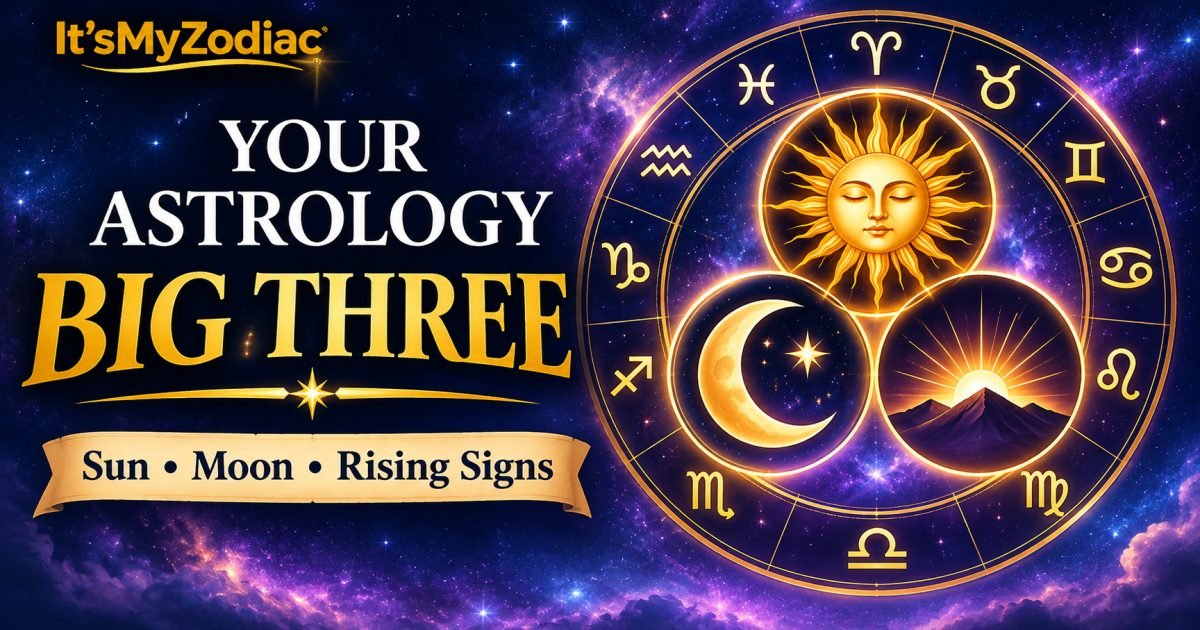
The Big Three refer to the Sun, Moon, and Rising signs in your natal birth chart. Each represents a different part of your astrological profile.
- Sun Sign: Represents your core identity, sense of purpose, and conscious self-expression.
- Moon Sign: Represents your emotional nature, instincts, and personal needs.
- Rising Sign: Represents your outward approach to life, first impressions, and how you meet new situations.
These are not three competing versions of your personality. They describe different dimensions of the same person. Looking at them together gives you a broader starting point for understanding your birth chart than reading your Sun sign alone.
1. Sun Sign: Your Core Identity
Your Sun sign is the zodiac sign the Sun occupied at the time of your birth in the tropical zodiac. It is the sign most people know when they say, "I'm an Aries" or "I'm a Capricorn."
In Western astrology, the Sun is associated with identity, vitality, confidence, personal direction, and the qualities you consciously develop over time.
It is often used to explore:
- Your basic sense of identity and individuality.
- What motivates you and gives you a sense of purpose.
- How you express confidence and creativity.
- The qualities you want to develop and express.
For example, a person with a Taurus Sun might be interpreted as valuing stability, consistency, and practical decision-making. Someone with a Sagittarius Sun might be associated with curiosity, independence, and a desire to explore new ideas.
Your Sun sign is a useful introduction to astrology, but it does not describe every aspect of your personality.
2. Moon Sign: Your Emotional Nature
Your Moon sign is the zodiac sign the Moon occupied when you were born. While the Sun is traditionally associated with conscious identity, the Moon represents your emotional world and instinctive responses.
Astrologers use the Moon sign to explore how someone processes feelings, responds to familiar situations, and experiences emotional comfort.
Your Moon sign is traditionally associated with:
- Your emotional needs and instinctive reactions.
- What makes you feel safe and comfortable.
- Your private feelings and inner experiences.
- How you respond to stress and emotional situations.
- The kind of emotional support you value.
For example, someone with a Cancer Moon might place considerable importance on emotional security, family connections, and feeling understood. A person with an Aquarius Moon might prefer emotional independence and a little more personal space when processing feelings.
This is one reason someone may not completely relate to the description of their Sun sign. Their Moon sign introduces another set of themes into the overall chart interpretation.
3. Rising Sign: Your Outer Approach to Life
Your Rising sign, also called your Ascendant, is the zodiac sign that was rising over the eastern horizon at the exact time and location of your birth.
Unlike your Sun and Moon signs, your Rising sign is particularly sensitive to birth time. The Ascendant changes throughout the day, moving through all twelve zodiac signs in approximately 24 hours.
In astrology, the Rising sign is associated with:
- Your first impressions and outward presentation.
- How you approach unfamiliar situations.
- Your natural way of initiating experiences.
- How you interact with your surroundings.
- The overall structure and starting point of your birth chart.
For example, someone with a Libra Rising might be interpreted as approaching new situations with diplomacy, consideration, and an interest in maintaining harmony. Someone with an Aries Rising may be associated with a more direct, energetic, and action-oriented approach.
The Rising sign also determines the starting point of the houses in your birth chart, making it an important placement in Western natal astrology.
Sun Sign vs. Moon Sign vs. Rising Sign: What's the Difference?
Although all three placements are important in popular Western astrology, they answer different questions about your personality and experiences.
| Placement | What It Represents | Key Question |
|---|---|---|
| Sun Sign | Core identity and personal direction | Who am I? |
| Moon Sign | Emotions and instinctive needs | How do I feel? |
| Rising Sign | Outward approach and first impressions | How do I meet the world? |
Think of the three placements as different pieces of a larger picture. Your Sun sign provides one perspective, your Moon sign adds emotional context, and your Rising sign describes how you approach the world around you.
How Do Your Sun, Moon, and Rising Signs Work Together?
The real value of understanding your Big Three comes from looking at how the three placements interact rather than interpreting each one separately.
Consider a fictional example of someone with:
- Leo Sun: Associated with creativity, confidence, and self-expression.
- Capricorn Moon: Associated with emotional restraint, responsibility, and a need for stability.
- Libra Rising: Associated with diplomacy, social awareness, and a balanced outward approach.
In a traditional astrological interpretation, this combination brings together three different sets of qualities. The Leo Sun emphasizes creative expression, the Capricorn Moon introduces a more reserved emotional style, and the Libra Rising adds a socially considerate approach.
This person might enjoy being recognized for their abilities while keeping their private feelings carefully managed. They may also place importance on maintaining positive relationships and presenting themselves thoughtfully.
This example shows why looking at only one zodiac sign can provide an incomplete picture. The combination creates a more detailed interpretation than any single placement can offer.
How to Find Your Sun, Moon, and Rising Signs
You can find your Big Three using a Western astrology birth chart calculator. However, you will need different birth information depending on the placement you want to identify.
Information You Need
- Birth date: Used to determine your Sun sign and begin calculating your Moon sign.
- Birth time: Important for an accurate Rising sign and for determining the Moon sign if the Moon changed signs on your birth date.
- Birthplace: Needed to calculate the local horizon and Ascendant accurately, as well as resolve the correct birth time zone.
Follow These Steps
- Find your birth date and, if possible, check your birth certificate for the recorded time.
- Identify your exact birthplace, including the city and state or country.
- Enter your birth information into a Western tropical birth chart calculator.
- Locate the Sun, Moon, and Ascendant placements in your chart.
- Read the meanings of all three placements together rather than focusing on only one.
If you do not know your birth time, you can usually still determine your Sun sign and may be able to determine your Moon sign. However, your Rising sign cannot be reliably calculated without an accurate birth time.
Why Your Birth Time Matters for Your Big Three
Not all three placements change at the same speed.
The Sun moves relatively slowly through the zodiac, spending approximately a month in each sign. This is why your birth date is usually enough to identify your Sun sign, although people born near a sign change may need the exact birth time.
The Moon moves much faster, changing zodiac signs approximately every two to two and a half days. If it changes signs on your birthday, your birth time can determine which Moon sign belongs to your chart.
The Rising sign changes even more quickly, moving into a different zodiac sign approximately every two hours on average. The exact timing varies with location and the zodiac sign involved.
This is why an approximate birth time may produce an incorrect Ascendant, particularly if you were born close to a sign transition.
Can Your Big Three Be in Different Zodiac Elements?
Yes. Your Sun, Moon, and Rising signs do not have to belong to the same element.
Western astrology groups the twelve zodiac signs into four elements:
- Fire: Aries, Leo, and Sagittarius.
- Earth: Taurus, Virgo, and Capricorn.
- Air: Gemini, Libra, and Aquarius.
- Water: Cancer, Scorpio, and Pisces.
For example, you could have a Fire Sun, an Earth Moon, and an Air Rising sign. Astrologers may interpret this as a combination of expressive identity, practical emotional needs, and an intellectually or socially oriented outward approach.
Having different elements in your Big Three is completely normal. It is one reason individual birth charts can have such varied combinations.
Frequently Asked Questions
What are the Big Three in astrology?
The Big Three are your Sun sign, Moon sign, and Rising sign. They represent three different dimensions of a birth chart: core identity, emotional nature, and outward approach to life.
Which is more important: Sun, Moon, or Rising sign?
There is no universally accepted ranking. The Sun, Moon, and Ascendant all have important roles in Western astrology. Their significance depends on the type of interpretation and the rest of the birth chart.
Can your Moon sign and Rising sign be the same?
Yes. Your Moon and Rising signs can be the same zodiac sign, even though they represent different placements and have different meanings. The same is true for your Sun and Rising signs or Sun and Moon signs.
Can you find your Rising sign without knowing your birth time?
Not reliably. Your Rising sign depends on the zodiac sign appearing on the eastern horizon at your birth location and exact birth time. Without that information, the Ascendant cannot be accurately established.
Why don't I relate to my Sun sign?
Your Sun sign is only one part of your birth chart. Your Moon, Rising sign, and other planetary placements contribute additional themes to your astrological interpretation. Exploring your Big Three can provide a broader perspective than reading a Sun sign description alone.
Do your Sun, Moon, and Rising signs change?
No. These are placements calculated from your birth moment, so they remain the same throughout your life. What can change is your understanding of how their traditional meanings relate to different experiences as you grow.
Final Thoughts
Your Sun, Moon, and Rising signs offer three different ways to explore your astrological birth chart. The Sun represents your core identity, the Moon relates to your emotional world, and the Rising sign describes your approach to life and the impression you make on others.
Instead of relying entirely on your zodiac Sun sign, take some time to discover your other two placements. Understanding how the three work together can make astrology more interesting and give you a stronger starting point for exploring your complete natal chart.
Remember that astrology is a symbolic tradition used for interpretation and self-reflection. These placements are not scientifically established measures of personality or guarantees of how someone will behave.